A Complete Guide to Israel For Christian Pastors & Pilgrims

For Christians, visiting Israel is more than a vacation – it’s a spiritual revelation that leaves a life-long imprint on your soul.
Whether you’re a pastor or parishioner, the Holy Land offers a once-in-a-lifetime opportunity to follow the footsteps of Jesus, witnessing firsthand where faith was born, taught, and transformed. From Jerusalem to the Sea of Galilee, eminent biblical sites bring the scriptures to life, providing tangible context for their enlightening verses.
For preachers and church-goers planning a pilgrimage to Israel, we’ve prepared this comprehensive Holy Land pilgrimage guide. Read on to learn about seasons, timeframes, logistics, destinations, and travel tips.
What to expect on a Holy Land tour
A Christian pilgrimage to Israel presents an immersive mix of history and faith. Rather than ticking historical sites off a bucket list, pilgrims develop a deeper connection to Christ and his homeland. Many return, declaring it the “best experience of their life.”
Typical Holy Land tours cover the main biblical sites in Jerusalem and the Sea of Galilee, and perhaps a few others depending on the timeframe. Days are often long and structured, but with plenty of time to read the scripture, reflect, worship, and pray. Each destination entails moderate walking, though tours can be tailored to your requirements.
How to plan a Christian pilgrimage to Israel
Start by reflecting on your favourite verses and compiling a hit list of biblical sites. While the majority reside in Jerusalem and the Sea of Galilee region, some important biblical locations, such as Caesarea Maritima, lie farther away, requiring additional travel time.
Discuss plans with your travel companions – fellow church-goers, pastors, family, etc. – and find a timeframe and budget that works for everyone.
Many pilgrims prefer talking to a professional travel agent. Sar-El Tours' local consultants have extensive real-world experience and can tailor-make a bespoke itinerary over the phone. We also partner with travel agents worldwide – ask yours to contact us.
Best time to visit Israel for a pilgrimage
For mild, temperate weather, the best time to visit Israel is during autumn (Sep-Nov) or spring (Mar-May). These moderate months bring pleasant temperatures and minimal rainfall, a big plus for open-air destinations.
Peak pilgrimage season runs from April or May due to lusher landscapes and near-perfect weather. As the wildflowers bloom, a kaleidoscope of color engulfs the outlying hills, providing an eye-catching backdrop. Just be aware that the most famous biblical sites, such as the Church of the Holy Sepulchre, get crowded in peak season.
Summer is sizzling hot in Israel. Most tours favor the milder highland climate of Jerusalem, while few visitors brave the scorching heat of the Judean Desert and Dead Sea.
Israeli winters are relatively mild compared to Europe and North America. Precipitation increases during this season, and snow occasionally falls in Jerusalem.
For more information, read our post on the Best Time to Visit Israel.
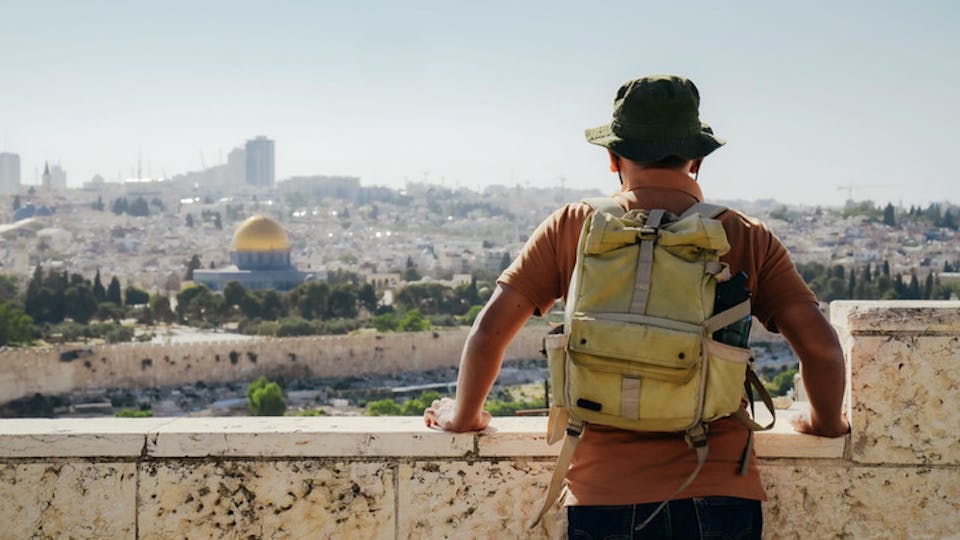
How long do you need for a Holy Land Tour in Israel?
Most Christian tours in Israel last from 7 to 14 days. Although shorter trips are doable, most pilgrims prefer to stay at least a week, given the variety of sites and distance from their homelands.
A typical 7 to 10-day tour covers Jerusalem and the Sea of Galilee, often with side trips to Bethlehem and Nazareth. These exhilarating, fast-paced excursions cover the main biblical sites, plus a smattering of lesser-known attractions, making them perfect for first-timers.
With 10 to 14 days, pilgrims can visit a few far-flung destinations, perhaps adding the Dead Sea, Mount Carmel, Judean Desert, or Caesarea Maritima to the list.
Sar-El Tours can tailor an itinerary based on your preferences and timeframe.
Self-guided travel versus booking a tour
About 80% of Christian pilgrims visit Israel on an organised tour. Tailor-made for faith-based travelers, our guided excursions include transport, accommodation, dinners and breakfasts, and entry fees.
Tour guides handle the logistics, saving pilgrims significant time and hassle. Guests can explore more places without worrying about the language barrier. On pastor-led tours, a theologian interweaves meaningful biblical context.
Some repeat visitors choose self-guided trips when flexibility and cost are top priorities. Independent travel allows for more off-the-beaten-track exploration and a slower pace. However, going solo is slow and fraught with logistical challenges. Plus, some biblical sites are inaccessible without private transport.
| Organised tours | Self-Guided travel | |
|---|---|---|
| Logistics | The company handles everything | Pilgrim must arrange transport, accommodation, meals, sightseeing, etc |
| Pacing | Fast-paced, visiting more sites in a shorter timeframe | Flexible, but can’t see as many places |
| Biblical Insights | Guides or pastors share knowledge of the scripture | Research your own |
| Social Experience | Communal experience with fellow pilgrims from around the world | Less likely to meet other pilgrims |
| Cost | Excellent value due to the convenience and inclusions | Savings possible at the cost of convenience |
| Access | Can visit any biblical site in Israel | Some places difficult to reach without a car and/or a guide |
| Best for | First-time pilgrims visiting multiple famous sites in a short timeframe | Repeat travelers seeking independence |
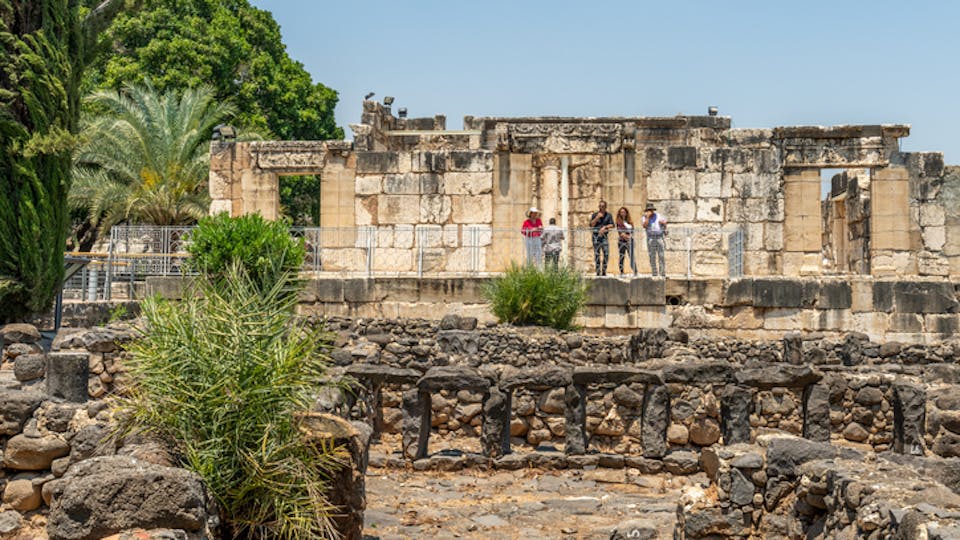
Getting Around Israel
Israel is a small, compact country, approximately the size of Slovenia or New Jersey. This diminutive stature, combined with well-developed transport infrastructure, means getting around the country is quick and easy.
All destinations of biblical interest reside within a three-hour drive of Jerusalem, in the approximate centre of the country.
| Route | Distance | Typical drive time |
|---|---|---|
| Jerusalem - Bethlehem | 6 mi (10 km) | 20–30 mins |
| Jerusalem - Jericho | 16 mi (25 km) | 40–50 mins |
| Jerusalem - Tel Aviv | 34 mi (55 km) | 1 hr |
| Jerusalem - Nazareth | 93 mi (150 km) | 2–2.5 hrs |
| Jerusalem - Sea of Galilee | 106 mi (170 km) | 2.5–3 hrs |
| Jerusalem - Dead Sea (Southern Israel) | 68 mi (110 km) | 2 hrs |
| Tel Aviv - Caesarea | 34 mi (55 km) | 1 hr |
| Tel Aviv - Nazareth | 65 mi (105 km) | 2 hrs |
| Nazareth - Sea of Galilee | 25 mi (40 km) | 45 mins |
| Sea of Galilee - Caesarea Philippi | 40 mi (65 km) | 1 hr |
Guided transport
The best Holy Land tour companies cover all transportation throughout your trip, including airport pickup and drop-off. Sar-El Tours itineraries include door-to-door transport in modern, air-conditioned coaches. We optimise routes to minimize driving and allow more time for reflection at biblical sites.
Sar-El Tours can adjust itineraries to accommodate pilgrims of differing mobility levels.
Public transport
Israel has an extensive system with signage posted in English. However, public transport generally runs between urban centres rather than Christian sites, making independent travel slow and tedious for pilgrims. Transportation is limited during Jewish Shabbat, from sundown Friday until sundown Saturday.
The state-owned Israel Railways Ltd. operates regular services between major cities (Jerusalem, Haifa, and Tel Aviv Airport, etc.). Egged and Dan are the leading regional bus companies.
Domestic flights are rare owing to Israel’s compact size. Some local airlines fly between Tel Aviv and Eilat, should you fancy a post-pilgrimage beach vacation.
Tel Aviv and Jerusalem have light rail networks. Metered taxis are available in busier urban centres – hail one from the street or phone ahead. Ride-sharing services (there’s no Uber, so try Bolt, Gett, or Yango) offer user-friendly apps and slightly lower rates.
Flights to Israel
Almost all international flights use Ben Gurion International Airport (TLV) near Tel Aviv. From there, a train connects to Jerusalem Central Station in under an hour.
Most direct flights between Tel Aviv and the United States are via New York (Delta, El Al, Arkia, American) with an approximate flight time of 11 hours. East Coast alternatives include Boston (El Al), Chicago (United), and Washington (United). From the West Coast, Delta and El Al fly direct from Los Angeles.
Air Canada operates a direct service from Toronto to Tel Aviv and a seasonal service from Montreal.
British pilgrims can fly direct from London to Tel Aviv on British Airways, El Al, or Wizz Air. Numerous European airlines connect Tel Aviv with their respective hubs, including Lufthansa, Air France, Iberia, KLM, and ITA.
Australia and New Zealand have no direct flights to Israel. Most pilgrims fly via the Middle East on Emirates and Etihad Airways.
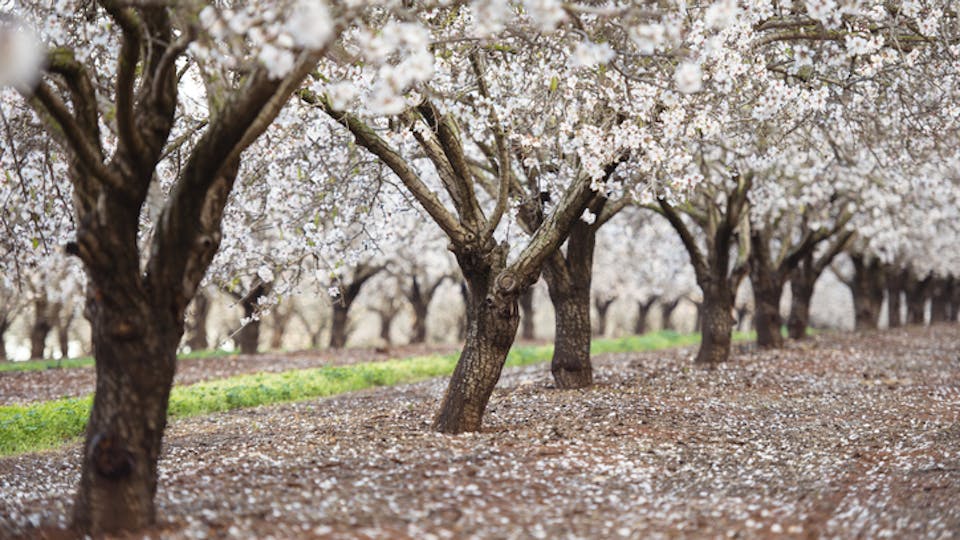
The best biblical sites to visit in Israel
As the birthplace of Christianity, Israel has more biblical sites than anywhere else on Earth. Here are some of the most popular places for Christians.
Biblical sites in Jerusalem:
- Church of the Holy Sepulchre: An iconic church where Jesus, according to most scholars, was crucified and buried before his Resurrection (Matthew 28:6).
- Via Dolorosa: The route in which Jesus carried the cross from his condemnation to crucifixion, marked by the 14 Stations of the Cross.
- Mount of Olives: A hilltop overlooking the Old City where Jesus taught his Disciples (Matthew 26:36-39) and later ascended to heaven (Acts 1:9–12).
- Mount Zion: A sacred mountain where Jesus shared his Last Supper (Luke 22:19–20) and where the Holy Spirit began Christianity during the Pentecost (Acts 2:1–4).
- Garden Tomb: A peaceful, alternative site where some Evangelicals believe Jesus was laid to rest.
- Temple Mount: A hilltop where Christians believe Jesus taught disciples and performed miracles (Matthew 21:12–14), and where Solomon's Temple once stood.
- Bethlehem: A neighbouring ancient city where Jesus was born to the Virgin Mary (Luke 2:6–7).
Biblical sites in the Sea of Galilee:
- Capernaum: A ruinous old fishing village where Jesus lived with one of the first Christians, Peter the Apostle (Matthew 8:14–15).
- Mount of Beatitudes: A mountain where Jesus delivered one of his most famous teachings, the Sermon on the Mount (Matthew 5:1–12).
- Tabgha: A village where Jesus fed famished followers in the Multiplication of the Loaves and Fishes (Matthew 14:19–21), and commissioned Saint Peter to lead the church (John 21:15–17).
- Mount Hermon: A lofty mountaintop and possible site for the Transfiguration of Jesus (Matthew 17:1–2)
- Nazareth: Jesus’ hometown, where he spent much of his childhood (Matthew 2:23).
- Yardenit: A busy baptismal site on the Jordan River.
Other Holy Land biblical sites:
- Caesarea Maritima: An old Roman port city where Peter the Apostle baptised Cornelius (Acts 10:47–48) and the Pilate Stone was discovered.
- Jericho: A remote ancient city where Joshua led the Israelites in the Battle of Jericho.
- Mount of Temptation: A mountain where Jesus fasted for 40 days after being tempted by the devil (Matthew 4:1–11).
For more details, read our post on the Top Biblical Sites to Visit in Israel.
Practical Tips for Christian Pilgrims
We’ve compiled a few practical tips to help you better prepare for your Holy Land tour.
What to pack on a pilgrimage to Israel
A Holy Land packing list is similar to other vacation destinations.
- The Bible
- Climate-appropriate clothing. Most religious sites require attire covering the shoulders and knees.
- Sunscreen, sunglasses, and a hat, especially during the warmer months.
- Comfortable walking shoes
- Toiletries and medications
- Passport, travel documents, travel insurance, multiple credit/debit cards
- Electrical outlet travel adapter
Israeli electrical outlets
Israel uses Type C plugs, the European style with two round pins, as well as Type H, a unique Israeli outlet with a third round pin for grounding.
Type C plugs almost always fit with type H outlets. Therefore, in practice, you only need an adapter that converts your home country’s plug to Type C.
Israel runs on 230V. Most handheld electronic devices, such as laptops, phones, and shavers, have dual-voltage chargers.
Cultural etiquette
Understanding local norms helps you travel respectfully, avoid offense, and enjoy positive cross-cultural interactions.
- Cover your shoulders and knees at religious sites (consider a scarf or shawl), and act quietly and courteously.
- Understand that photography is culturally insensitive and most businesses close (including public transport) on the Sabbath, from Friday sunset to Saturday sunset.
- Remain respectful and open-minded when discussing faith or culture with local Israelis.
- Ask permission before photographing local people and approach political conversations with caution and respect.
Accessibility & walking
With cobblestone pathways and infrequent handrails, many ancient sites have limited accessibility to pilgrims with mobility issues. A tour guide can help navigate these challenges.
A moderate amount of fitness is needed. Typical itineraries require 3–6 miles (5–10 km) of walking per day, plus several hours of standing. Common obstacles include rough pathing, uneven stairs, steep inclines, thick crowds, and heat.
Guides usher pilgrims between shady spaces as much as possible, but some direct sun exposure is unavoidable. Sar-El Tours can create customised itineraries for pilgrims with mobility issues.
Plan Your Holy Land Adventure with Sar-El Tours
With three decades of on-the-ground experience, Sar-El Tours is among the largest and most trusted faith-based tourism operators in Israel.
Our team has made Holy Land tours a reality for over a million Christian pilgrims, primarily from the USA, Canada, the UK, Australia, and New Zealand. We partner with the Ministry of Tourism and the Israeli Union of Hotels and operate our own fleet of luxurious, air-conditioned coaches.
Use the contact form below to get in touch with an in-house consultant, who can tailor-make Faith Pilgrimages and Church Group Tours of Israel. Alternatively, if you are a pastor, we can connect you with a travel agent in your country.